
Long before castles dotted the Irish landscape, long before monks built their stone abbeys along quiet riverbanks, Ireland was already home to communities whose presence still shapes the island today. The Celtic tribes in Ireland left behind a legacy written into hillforts, burial mounds, and oral traditions that survived for thousands of years before anyone wrote them down.
Walking through Ireland’s ancient stories means moving across an extraordinary span of time, from prehistoric settlement through Celtic culture, early Christianity, and finally the medieval castles that still define much of the country’s visual identity today. Few places in Europe offer this kind of unbroken, walkable timeline.
Before the Celts: Ireland’s Neolithic Foundations
Ireland’s human history actually predates the Celts by thousands of years. Newgrange, built around 3200 BC, is older than both Stonehenge and the Egyptian pyramids, constructed by Neolithic farming communities whose engineering skill remains genuinely astonishing. The passage tomb is aligned precisely with the winter solstice sunrise, a feat of astronomical observation that speaks to a level of sophistication rarely associated with prehistoric societies.
The wider Boyne Valley, where Newgrange sits alongside the related monuments of Knowth and Dowth, represents one of the most significant Neolithic landscapes anywhere in Europe, predating even the arrival of farming in much of northern Europe.
The Arrival of Celtic Culture
The arrival of Celtic culture in Ireland, generally dated to sometime in the first millennium BC, brought language, social structure, and artistic traditions that would shape the island for over a thousand years. Celtic tribes in Ireland organised themselves into distinct kingdoms, each centred on a ruling family and a network of alliances that shifted constantly through warfare and marriage.
The Hill of Tara emerged as the most significant of these centres, serving as the symbolic seat of the High King of Ireland and the location of major Celtic ceremonial gatherings for centuries, its earthworks still clearly visible across the gently rolling Meath countryside today.
Celtic Law, Mythology, and Craftsmanship
Celtic Ireland left behind a rich tradition of mythology, law, and craftsmanship that continued to influence the island long after the arrival of Christianity. The Brehon Laws, an intricate legal system unique to Celtic Ireland, governed everything from property disputes to personal injury compensation with a level of sophistication that surprised early scholars studying the surviving manuscripts.
Celtic metalwork, visible in artefacts held in the National Museum of Ireland, demonstrates a level of craftsmanship that rivalled anything produced elsewhere in contemporary Europe, particularly in gold and bronze ornamentation, much of which was recovered from bogs and burial sites across the midlands.
Christianity Merges With Celtic Tradition
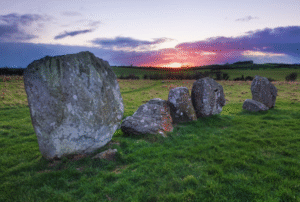
The arrival of Christianity in the fifth century did not erase Celtic culture so much as merge with it, producing a distinctly Irish form of monasticism that became renowned across early medieval Europe. Monasterboice, with its intricately carved High Crosses dating to the tenth century, illustrates how Christian iconography absorbed Celtic decorative traditions rather than replacing them outright, blending interlaced Celtic patterns with biblical narrative scenes.
Mellifont Abbey, founded in 1142, represents a later wave of monastic development, when continental religious orders began establishing formal foundations across the Irish landscape, building on the foundations laid by earlier native monastic communities and introducing Cistercian architectural style to Ireland for the first time.
The Viking Interlude
Between the early Christian period and the arrival of the Normans, Viking raiders and settlers added another layer entirely to Ireland’s story. Coastal monasteries were frequent targets, but Viking settlement also established several of Ireland’s most significant cities, including Dublin and Waterford, both founded as Norse trading ports in the ninth and tenth centuries.
This period is often underappreciated in popular accounts of Irish history, yet it fundamentally shaped the island’s urban development and left a genuine, lasting mark on Irish surnames, place names, and coastal settlement patterns that persists today. Many families pursuing genealogy in Ireland eventually trace a surname back to this Norse influence without realising it at the start of their research.
The Rise of Medieval Castles
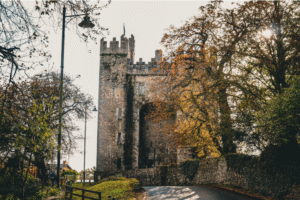
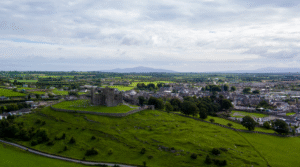
The medieval period brought a new architectural language to Ireland, largely introduced by Norman invaders following their arrival in 1169. Trim Castle, the largest Anglo-Norman castle in the country, demonstrates the scale and military sophistication these new arrivals brought with them, its keep and curtain walls still dominating the landscape along the River Boyne over eight centuries later.
Kilkenny Castle, similarly, reflects the wealth and power of the Butler family, who controlled the surrounding region for centuries and left behind one of Ireland’s most architecturally significant medieval strongholds, its grounds and gardens still drawing visitors today.
A Landscape Layered With History
What makes exploring Ireland’s ancient history so rewarding is how visibly these different eras layer on top of one another within remarkably small areas. A single day in County Meath can take in a five-thousand-year-old passage tomb, the seat of Celtic high kings, a medieval Anglo-Norman castle, and a monastic site spanning multiple centuries of Christian history, all within a relatively short drive.
This concentration of layered history is rare anywhere in Europe, and it rewards visitors who take the time to understand how each period connects to the next rather than treating these sites as isolated curiosities scattered across the countryside. Many visitors combine this kind of day with family history tours, since ancestral sites often sit within the very same landscape.
Walk Through Ireland’s Story With Us
At Royal Historical Tours, we guide visitors through the full sweep of Ireland’s ancient story, from the Neolithic monuments of the Boyne Valley to the Celtic ceremonial sites at the Hill of Tara, the early Christian monasteries of Monasterboice and Mellifont, and the medieval splendour of Trim Castle.
Based in County Meath, one of the most historically dense regions in the country, our certified guides bring genuine expertise to every era, helping visitors understand not just what each site is, but how it connects to everything that came before and after it.
Our ancient monuments and castles tours are entirely private, picked up and dropped off at your hotel, and shaped around your specific interests. Visitors drawn to the Celtic tribes in Ireland and their lasting influence will find our history tours of Ireland particularly rewarding, while our broader Ireland historical tours weave in medieval and monastic sites for a fuller picture. Whether you are drawn to Celtic mythology, medieval architecture, or the earliest chapters of Irish Christianity, our Ireland cultural tours bring thousands of years of history vividly to life.
Contact Royal Historical Tours today to start exploring Ireland’s ancient stories for yourself.