
What if we could walk through 5,000 years of Irish history in the space of a single trip?
That is exactly what makes Ireland’s Ancient East so compelling. Across 12 counties, this region brings together prehistoric monuments, ancient ceremonial sites, early Christian settlements, Viking towns, medieval abbeys and imposing castles. Some of its heritage reaches back more than 5,000 years, giving us an opportunity to follow Ireland’s development through the places where its history unfolded.
At Royal Historical Tours, we find County Meath particularly valuable as the starting point for this story. Newgrange, the Hill of Tara and Trim Castle allow us to move from Neolithic society to ancient kingship and then into the medieval period, while sites farther east and south add the stories of Christianity, Viking settlement and Norman rule.
In this guide, we will move chronologically through Ireland’s past, examining what we actually see at major heritage sites and how we can connect them into a meaningful Ireland heritage trip.
Our Story Begins 5,000 Years Ago at Newgrange
When we stand before Newgrange in County Meath, it can be difficult to grasp just how old the monument is.
The great passage tomb was constructed during the Neolithic period, around 3200 BC, making it older than Stonehenge and the Egyptian pyramids. Its age alone makes it remarkable, but the monument becomes even more fascinating when we consider the planning and skill required to create it.
Newgrange forms part of the Brú na Bóinne complex, together with Knowth and Dowth and a large collection of other prehistoric monuments.
What We Actually See at Newgrange
As we approach Newgrange, the first feature that captures our attention is the enormous circular mound. Its outer edge is surrounded by kerbstones, many of which feature carved designs.
We then enter the narrow passage that leads toward the central chamber.
The passage and chamber are constructed from huge stones, but the builders created the structure without modern machinery or engineering equipment. The stones had to be selected, transported and positioned with remarkable care.
Inside, the chamber has a corbelled roof, created by gradually placing stones inward until they met above the central space.
The monument also contains one of its most famous features: the roof box above the entrance.
During sunrise around the winter solstice, sunlight can pass through the roof box and travel down the passage into the chamber. This relationship between the monument and the sun provides important evidence of the astronomical and ceremonial knowledge possessed by the people who built it.
When we visit Newgrange, therefore, we are not simply looking at an old burial monument. We are seeing evidence of a society capable of organizing substantial communal construction and incorporating the movements of the sun into its ceremonial practices.
That makes Newgrange an essential starting point for Ireland history tours.
Knowth and Dowth Add More to the Prehistoric Story
We cannot understand Brú na Bóinne by focusing on Newgrange alone.
Knowth contains a major passage tomb complex with two passages and extensive examples of prehistoric art. The monument was used and modified over different periods, showing us that these locations continued to hold significance long after their original construction.
Dowth provides another important connection.
Its prehistoric monuments were later surrounded by evidence of activity from subsequent periods. This gives us a useful reminder that Ireland’s ancient sites were not frozen in time. People continued to return to important places, reinterpret them and use the surrounding areas for different purposes.
As we move between Newgrange, Knowth and Dowth, we begin to see a larger picture of prehistoric Ireland.
We see communities gathering around significant places.
We see monuments designed around death, ritual and seasonal cycles.
We see artistic traditions preserved in stone.
Most importantly, we see that the Boyne Valley was already an important center of human activity thousands of years before the medieval castles and churches that dominate so many modern images of Ireland.
For travelers interested in Ireland’s cultural history, this is one of the most rewarding places to begin.
From Prehistoric Monuments to Ancient Kingship at Tara
After visiting the Boyne Valley, we can move south toward the Hill of Tara.
Tara gives us a very different experience.
Newgrange allows us to enter a prehistoric monument and see its physical construction. At Tara, much of what we encounter consists of earthworks, mounds, banks and ditches.
Yet these features tell an equally important story.
Tara became associated with Irish kingship and political authority, particularly through its connections with the traditional High Kings of Ireland. The site was also used for ceremonial purposes and contains monuments dating from several different periods.
Reading the Hill of Tara
One of the most important things we can do at Tara is resist the temptation to expect a conventional palace.
There is no grand stone royal residence waiting for us.
Instead, we see the remains of a complex ceremonial center.
Among the features we can identify are:
- The Mound of the Hostages, a prehistoric passage tomb.
- Ráth na Ríogh, or the Fort of the Kings.
- The Lia Fáil, traditionally connected with the inauguration of kings.
- The Banqueting Hall, represented today by a long earthwork.
- Other enclosures and monuments associated with different periods of activity.
The Mound of the Hostages is particularly interesting because it takes us back into prehistoric Ireland while also sitting within a site later associated with kingship.
That overlap is central to understanding Tara.
The meaning of a place could change as society changed.
A location first associated with prehistoric burial and ceremony could later become connected with political authority, royal traditions and Christian stories.
St. Patrick and the Christian Transformation of Ireland
As we move into the early Christian period, the character of Irish society begins to change.
Christianity became established in Ireland from the fifth century onward, and monasteries grew into important centers of religious life, learning, craftsmanship and economic activity.
The Hill of Slane, not far from Tara, is often included in this part of the story because of its association with St. Patrick. According to tradition, Patrick lit a paschal fire on Slane Hill while the High King was celebrating a pagan festival at Tara.
Whether every detail of the traditional account can be established historically is a separate question, but the story demonstrates how closely Christian traditions became connected with older centers of authority.
This period is especially important because early Christian Ireland did not simply erase what came before.
Instead, older sites, traditions and places of authority could acquire new meanings.
That pattern becomes clearer when we visit monastic centers such as Glendalough.
Glendalough and the World of Early Christian Ireland
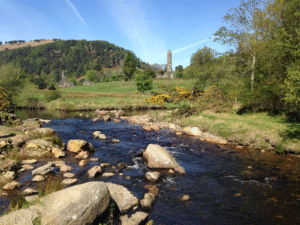
When we arrive at Glendalough in County Wicklow, we encounter one of Ireland’s most impressive early medieval monastic sites.
The settlement was founded by St. Kevin in the sixth century and developed into a major religious center.
Today, we can see the remains of several churches, a cathedral, crosses, a gateway and the famous round tower.
FAQs About Ireland’s Ancient East
- What are some of the most important historical sites to visit in Ireland’s Ancient East?
We recommend beginning with Newgrange, Knowth, the Hill of Tara and Trim Castle in County Meath. We can then add Glendalough, Waterford’s Viking Triangle, Kilkenny Castle, Jerpoint Abbey and the Rock of Cashel to understand later periods. This combination gives us access to prehistoric, early Christian, Viking and medieval history.
- How much time should we allow for an Ireland heritage trip?
For County Meath, two days give us enough time to visit the major sites at a comfortable pace. For a wider trip covering Meath, Wicklow, Waterford, Kilkenny and Tipperary, we suggest allowing at least five to seven days. More time gives us the opportunity to add smaller heritage sites and spend longer at major monuments.
- Can we visit Newgrange, Tara and Trim Castle in one day?
We can combine all three in a single day with careful planning. However, we need to account for scheduled access at Brú na Bóinne, travel time between locations and the time required to appreciate each site. Starting early can make this itinerary more practical.
- What is the difference between Newgrange and the Hill of Tara?
Newgrange is a Neolithic passage tomb associated with prehistoric burial and ceremonial practices. Tara contains monuments from several periods and became strongly associated with Irish kingship and ceremonial authority. Visiting both allows us to see how different forms of power and belief developed across the same region.
- Where can we learn about Viking history in Ireland’s Ancient East?
Waterford is an important destination for Viking history. The city was established as a Viking settlement in the early tenth century and became a significant trading center. Its Viking Triangle and associated museums allow us to examine the archaeological and historical evidence for this period.
- How can we combine prehistoric and medieval sites during one trip?
County Meath makes this particularly straightforward. We can visit Newgrange and Knowth for prehistoric Ireland, the Hill of Tara for ancient kingship and Trim Castle for the Anglo-Norman period. We can then continue toward Glendalough, Waterford, Kilkenny or Cashel to add early Christian, Viking and later medieval history.
From Newgrange to Trim: Seeing Ireland’s History as One Connected Story
What can we really understand when we stand among monuments built thousands of years apart?
For us, the answer lies in the connections.
- At Newgrange, we see evidence of a prehistoric society capable of monumental construction and careful observation of the sun.
- At Tara, we encounter a place where ancient ritual traditions became connected with kingship and political authority.
- At Glendalough, we see the growth of Christian communities that became important centers of religion, learning and pilgrimage.
- At Waterford, we encounter the arrival and settlement of Vikings and the growth of an important trading town.
- At Trim, we see medieval authority expressed through one of Ireland’s largest castles.
- At Cashel and Kilkenny, we see the continuing relationship between political power, religion, architecture and urban development.
When we connect these places, Ireland’s history becomes easier to understand.
The monuments are no longer isolated attractions.
Newgrange helps us understand the age and sophistication of prehistoric Ireland. Tara shows us how places could gain new political and ceremonial meaning. Early Christian sites reveal a transformation in religious and social life. Viking towns demonstrate the importance of trade and settlement. Norman castles show how military and political structures changed again.
This is why we believe an Ireland heritage trip should give us time to make connections between sites rather than simply count how many attractions we can visit.
At Royal Historical Tours, we can help travelers bring these connections into a coherent itinerary centered on the history, architecture and cultural heritage that interest them most.
For those considering Ireland historical tours, Ireland history tours, historical tours in Ireland or Ireland cultural tours, we invite you to contact us and discuss the places and periods you want to experience. We can help bring together prehistoric monuments, ancient royal centers, monasteries, Viking heritage and medieval castles so that each stop contributes to a broader understanding of Ireland’s past.
The story of Ireland’s Ancient East is not confined to one monument or one century.
It stretches from the builders of Newgrange to the kings associated with Tara, from early Christian communities to Viking settlers, and from medieval lords to the castles and towns that still shape our view of Ireland today.
When we visit these places with that wider context in mind, every mound, stone, church, tower and castle gives us another piece of the story.
And together, those pieces show us how Ireland developed across thousands of years.