
When time is limited, every stop matters. Dublin offers centuries of history within a relatively compact area, but getting from one historic district to another by car requires planning, especially when city traffic and parking can slow us down. The city’s Phoenix Park alone covers around 1,750 acres, showing just how much history and heritage can sit within Dublin’s boundaries.
For us, Dublin by car works best when we have a clear route rather than trying to visit every famous attraction. With the right order of stops, we can combine major landmarks with historic neighborhoods, memorials, old streets, and quieter places that many short visits miss.
This guide shows how we can organize one productive day while leaving enough time to stop, walk, and absorb the character of each area.
Start Early and Build the Day Around Districts
A successful day in Dublin begins before the streets become busy. Rather than choosing individual attractions at random, we can group nearby locations together and move gradually from one part of the city to another.
This approach gives us several advantages:
- Less time spent crossing the city repeatedly
- More time for historic sites and short walks
- Easier parking planning
- Greater flexibility when an attraction is busy
- More opportunities to see neighborhoods beyond the major visitor spots
Dublin City Council advises drivers to follow local parking restrictions, with restrictions applying to areas such as bus lanes, cycle tracks, yellow lines, pedestrian areas, and junctions. Planning where we will leave the car before reaching each district can save valuable time.
For a one-day visit, we should think of the car as a way to connect areas rather than something we need beside us at every attraction. In the central districts, we can park legally and continue on foot for short stretches.
Morning: Begin Around Dublin’s Historic Core
We can begin the morning around Trinity College and College Green, one of the most recognizable parts of central Dublin. Trinity College dates to the sixteenth century and remains closely associated with Irish education, literature, and cultural history. Its Old Library and the Book of Kells are particularly significant for visitors interested in Ireland’s past.
From here, we can continue toward Dublin Castle and the surrounding streets. This area gives us a useful introduction to how Dublin developed from its medieval foundations into the political and cultural center we see today.
Rather than spending the entire morning inside attractions, we can combine indoor visits with short walks around the surrounding streets.
A Practical Morning Sequence
- Start around Trinity College and College Green.
- Continue toward Dublin Castle.
- Walk through the surrounding historic streets.
- Visit Christ Church Cathedral if time allows.
- Continue toward the Liberties.
This section of Dublin is particularly useful for anyone interested in historical tours in Ireland because several periods of the city’s history appear within a relatively short distance.
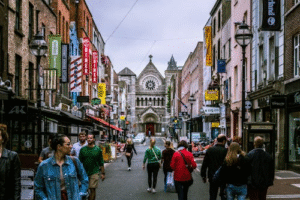
Visit the Liberties for a Different Side of Dublin
The Liberties gives us a very different experience from the formal streets around Trinity College. This historic district has long associations with trade, brewing, religious institutions, crafts, and working communities.
We can pass through areas around St Patrick’s Cathedral, Christchurch, and the older streets leading toward the Guinness district. The purpose is not to rush through a checklist. Instead, we can use the car to reach the area efficiently, park appropriately, and then spend some time walking.
This is also where a flexible route becomes valuable. If one attraction has a long queue or does not fit our schedule, we can continue to another nearby historic site instead of losing a large part of the day.
Midday: Stop at the Irish Famine Memorial in Dublin
For visitors interested in family history, the Irish Famine Memorial in Dublin deserves a place on the route.
The memorial near Custom House Quay provides a powerful reminder of the Great Famine and the hardship experienced by Irish families during the nineteenth century. For many families with Irish ancestry, this part of Dublin can add personal meaning to a heritage-focused visit.
We can spend time at the memorial before continuing along the quays. This also creates an opportunity to think about migration, family separation, and the reasons so many Irish people eventually established lives overseas.
For those researching relatives who left Ireland, a visit like this can add historical context that records alone cannot provide.
Afternoon: Drive Toward Phoenix Park
After the central districts, we can use the car for one of the day’s more spacious sections by heading toward Phoenix Park.
The park contains several historically significant locations, including the Wellington Monument, the Phoenix Monument, Ashtown Castle, and the residence of the President of Ireland. It also has connections to Ireland’s political and social history.
We do not need to attempt every stop. Instead, we can choose a few points based on our interests and available time.
For families, this can be one of the more relaxed parts of a one day family heritage tour. After several hours among museums, churches, monuments, and city streets, having room to walk and pause can make the day more enjoyable.
One Day Can Still Create a Meaningful Heritage Experience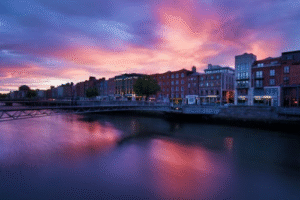
Caption: Coastal ports played a critical role in Irish emigration as families departed in search of survival and opportunity.
What if one day in Dublin could tell us more about Ireland than a long list of famous attractions?
For us, the answer comes from choosing connections rather than simply counting stops. Trinity College can introduce Dublin’s intellectual history, the medieval center can show the city’s older foundations, the Irish Famine Memorial in Dublin can connect us with the experiences of Irish families, Phoenix Park can provide a broader historical setting, and Kilmainham can bring us closer to the political events that shaped modern Ireland.
That is also what makes Ireland heritage tours so rewarding for families and visitors with ancestral connections. We do not need to see everything to create a meaningful day. We need a route that reflects what matters to us.
For travelers interested in genealogy, this approach can be especially useful. A one day family heritage tour can combine recognizable landmarks with places connected to Irish history and family research. Likewise, private heritage tours of Ireland can give visitors greater control over timing, stops, and the historical themes they want to focus on.
Royal Historical Tours can help us make that limited time count through private heritage tours of Ireland and personalized Ireland excursions built around our interests.
If we want to connect Dublin’s historic sites with a deeper interest in Irish ancestry and heritage, contacting Royal Historical Tours can help us create a focused itinerary that makes practical use of our time while bringing more historical context into the day.