
What’s older than the pyramids, sits an hour from Dublin, and still gets overlooked by most first-time visitors?
Newgrange, in County Meath, was constructed around 3,200 BC, making it roughly 500 years older than the Great Pyramids of Giza and 1,000 years older than Stonehenge, according to UNESCO’s own World Heritage listing for the Brú na Bóinne site.
That single fact tells you almost everything about why Meath deserves more attention than a quick stop on the way to somewhere else.
This county holds Ireland’s oldest large-scale monuments, its ceremonial seat of political power, its bloodiest turning point in the Williamite wars, and one of its largest medieval castles, all within a compact stretch of land north of Dublin.
This piece sets out Meath’s archaeological, religious, and medieval layers, and explains why the county carries particular weight for anyone researching Irish ancestry.
Few counties reward a proper visit the way Meath does, and few are as easy to rush past on the way to somewhere else. At Royal Historical Tours, we build trips specifically around this kind of layered history, and this guide sets out why Meath deserves more than a quick stop.
Brú na Bóinne: Ireland’s Neolithic Core
Long before Ireland had kings, it had farmers building monuments on a scale that still astonishes archaeologists. Brú na Bóinne, the bend of the River Boyne, contains three major passage tombs:
- Newgrange, the better known of the three, is a circular mound roughly 85 meters across and 11 meters high, ringed by 97 kerbstones, some carved with megalithic spiral art. Its inner passage aligns precisely with the rising sun on mornings around the winter solstice, flooding the burial chamber with light for a few minutes each year.
- Knowth, close by, holds the largest single collection of megalithic art found anywhere in Western Europe.
- Dowth, less excavated than its neighbors, is believed to carry its own solar alignment tied to the setting sun.
Together, the three sites were designated a UNESCO World Heritage Site in 1993, recognized as one of Europe’s largest and most significant concentrations of prehistoric monuments.
Newgrange Megalithic Tomb trips typically run through the official Brú na Bóinne Visitor Centre, since there’s no direct public access to the tombs themselves; visitors cross the River Boyne and reach the monuments by shuttle as part of a guided tour, which also helps protect the fragile passage interiors from unrestricted footfall.
The Hill of Tara: Where Ireland’s High Kings Ruled
A short distance from the Boyne Valley sits the Hill of Tara, the traditional inauguration site and seat of the High Kings of Ireland from the Iron Age through the early medieval period.
According to Heritage Ireland, which manages the site, Tara’s importance predates the High Kings themselves, with a Neolithic passage tomb on the summit dating back roughly 5,000 years, but it was during the Iron Age and into the early Christian period that the hill became the political and ceremonial center of the entire island.
Standing at the summit, visitors can see across a significant portion of the country on a clear day, which historically made Tara a natural seat of power: whoever controlled Tara had visibility, symbolically and literally, over much of Ireland. The Lia Fáil, or Stone of Destiny, still stands at the site, traditionally said to have roared when touched by the rightful king.
Trim Castle and Meath’s Medieval Layer
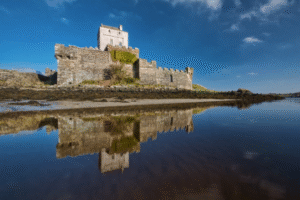
Meath’s medieval history is dominated by Trim Castle, built by the Anglo-Norman lord Hugh de Lacy starting in 1173, making it the largest Anglo-Norman castle in Ireland. Its scale reflects Meath’s strategic importance in the centuries following the Norman invasion: whoever held the Boyne Valley controlled a critical inland route and some of the country’s most productive farmland.
Meath’s medieval significance extends well beyond a single castle. The county was carved out as an Anglo-Norman lordship in its own right, and its monasteries, churches, and fortified sites reflect centuries of continuous settlement, conflict, and rebuilding.
For visitors interested in the fuller sweep of medieval Ireland, pairing Meath’s castles and monastic remains with Medieval Museum tours elsewhere in the country, such as Waterford’s collection of medieval artifacts and civic treasures, builds a much fuller understanding of how the Anglo-Norman and later medieval periods shaped Irish towns, church architecture, and land ownership across multiple counties.
The Battle of the Boyne
Meath’s River Boyne carries one more layer of historical weight: in July 1690, the Battle of the Boyne was fought near Oldbridge, just inside the county, between the forces of the deposed Catholic King James II and the Protestant King William III.
The outcome shaped the political and religious balance of power in Ireland for centuries afterward, and the site remains one of the most consequential battlefields in Irish and British history. The battlefield is preserved and open to visitors today, offering direct physical context for a conflict that’s frequently discussed in the abstract but rarely walked in person.
Building a Trip Around Meath’s Layers of History
Few counties compress this much of Ireland’s rich heritage into such a small area: Neolithic tombs, the seat of the High Kings, a major Anglo-Norman castle, and one of the most consequential battles in Irish history, all within a short drive of each other.
For visitors who want to see these layers properly rather than rush past them on a coach window, we build private guided Ireland tours and private Ireland tour packages around exactly this kind of concentrated history.
Alongside our customised multi-day tour packages covering Meath and the wider Boyne Valley, we offer historical and genealogy tours across the 32 counties of Ireland for travelers whose family research points toward this part of the country specifically.
If Meath’s combination of ancient monuments, medieval castles, and documented history has caught your interest, reach out and we’ll help build a trip around the sites and records that matter most to you.