
What are the odds your last name has Irish roots?
Higher than you might think. In the United States alone, 32.4 million people, or 9.5% of the population, claimed Irish ancestry in 2024, according to the U.S. Census Bureau’s American Community Survey. Add in the descendants of Irish emigrants across Canada and Australia, and the pool of people with a family story that starts somewhere on this island is enormous.
Yet most of that research stalls at the same point: a surname, maybe a county, and no clear next step. This guide walks through the records that actually exist, how townlands and parishes work, what survived a catastrophic archive fire, and what a traveler can realistically do once an ancestral location is identified.
This is also where local expertise tends to matter most, since records only tell you where to look, not always what you’ll find once you get there. At Royal Historical Tours, we work with descendants at exactly this stage, turning a townland name or parish register entry into an actual visit. This guide sets out the records worth chasing before you ever contact us.
Start With What’s Already at Home
Before touching an Irish archive, gather everything already sitting in family boxes and overseas record offices:
- Immigration and naturalization recordsfrom the destination country, which often list a precise birthplace, parish, or townland rather than just “Ireland.”
- Ship passenger manifests, which can include age, occupation, and last residence.
- Church records from the country of arrival, since baptismal or marriage entries sometimes name the home parish.
- Family letters, obituaries, and gravestones, which frequently mention a specific townland that never made it into any government form.
This step matters more than most researchers expect. Ireland’s records are organized by townland, parish, and civil registration district, not simply by county, so a specific place name from an overseas source can save weeks of searching.
Understanding Irish Civil Records
Civil registration is the backbone of Irish genealogy research, and it starts later than many overseas descendants assume:
- Non-Catholic marriageswere recorded from 1845.
- All births, marriages (including Catholic), and deathswere recorded from 1864 onward, held by the General Register Office and searchable through IrishGenealogy.ie, the Irish government’s free civil records portal.
- Records become publicly viewable on a rolling basis: birth records after 100 years, marriages after 75 years, and deaths after 50 years.
- In Northern Ireland, civil registration split off after 1922 and is now held separately by GRONI, accessible through PRONI, the Public Record Office of Northern Ireland.
A typical Irish birth record lists the parents’ names, the mother’s maiden name, the father’s occupation, and the townland, which is often the single most useful detail for planning a future visit.
Census Records: What Survived and What Didn’t
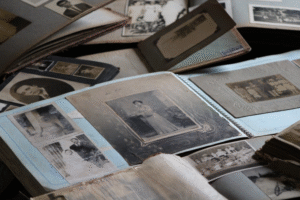
This is where Irish genealogy differs sharply from research in the United States or Britain. On June 30, 1922, an explosion and fire at Dublin’s Four Courts destroyed the Public Record Office of Ireland, and with it, most of the 19th-century census returns for 1821, 1831, 1841, and 1851, along with large portions of Church of Ireland parish registers and probate records. Only a handful of county fragments from that earlier period survived.
The good news:
The 1901 and 1911 censuses survived completely intact and are free to search online through the National Archives of Ireland.
Ongoing digital recovery projects have recovered tens of thousands of names from the destroyed 19th-century returns using surviving transcripts held elsewhere, so it is always worth a fresh search even on records once thought permanently lost.
Parish Registers and the Townland System
Church records fill much of the gap left by the fire, particularly for the years before 1864:
- Catholic parish registers, organized by parish rather than county, are searchable through the National Library of Ireland’s free online catalogue.
- Church of Ireland (Anglican), Presbyterian, and Methodist registers survive unevenly depending on the denomination and region, with roughly half of Church of Ireland registers lost in 1922.
- The townland, Ireland’s smallest official land division, is the key organizing unit for almost all pre-20th-century research. There are more than 60,000 townlands on the island, and a family’s records will typically cluster around one or two of them for generations.
Locating the correct townland transforms genealogy research from a documents exercise into a travel plan, since it tells you exactly where to stand.
Once You’ve Identified a Location: What Travelers Can Actually Do
Finding a townland or parish name on a document is the beginning, not the end. From there, descendants typically want to:
- Walk the actual landtheir ancestors farmed or lived on, which is often still identifiable by name even where buildings are long gone.
- Visit the local parish churchwhere baptisms and marriages took place, many of which still hold their own record books or point researchers toward diocesan archives.
- Read local graveyard inscriptions, which frequently confirm details that civil records leave out, such as exact birth years or family groupings.
- Consult local heritage centres, which often hold record sets more specific to that county than what’s searchable nationally online.
For descendants tracing Ulster roots specifically, a stop in Derry adds real depth to the trip.
Many family lines that funnelled through Ulster ports or Presbyterian congregations connect directly to Derry’s history, and historical tours of Derry covering the 17th-century walled city and the story of the 1689 siege give useful context for why so many Ulster Protestant and Presbyterian families emigrated in waves during the 18th century.
A private Derry walking tour along the only fully intact city walls in Ireland, paired with a Derry day tour through the Bogside and cathedral quarter, rounds out a research trip with the kind of on-the-ground context that a record alone can’t provide.
Turning Research Into a Trip
So what happens once the names, dates, and townlands are finally on paper? For many overseas descendants, the natural next step is standing on the actual ground the records point to.
We offer genealogy and family history trips across the 32 counties of Ireland, building each itinerary around the parish registers, civil records, and townland names our clients bring with them, whether that research points to a farmhouse in Donegal, a parish church in Cork, or a walled city like Derry.
Alongside genealogy tours of Ireland, we also arrange Irish heritage tours through castles and estates connected to specific family names, for descendants who want their trip to combine documented ancestry with the wider history of the places their family called home.
If you’ve traced a name or a townland and want to see it in person, reach out and we’ll help build the trip around what your research has already found.