
There is a period in Irish history—stretching roughly from the fifth to the twelfth century—that changed the course of Western civilisation. As learning collapsed across much of post-Roman Europe, Ireland’s monasteries became centres of extraordinary intellectual activity. Monks copied and preserved classical texts. Illuminated manuscripts of breathtaking complexity were produced. Saints founded settlements that grew into centres of pilgrimage, scholarship, and spiritual authority. A Saints and Scholars tour in Ireland traces this legacy through the landscapes and monuments that survive from that remarkable era.
Royal Historical Tours’ Saints and Scholars Tour Package is designed for travellers who want to understand not merely what these places look like, but what they meant—and continue to mean—to the people of Ireland. Led by certified expert guides, the experience connects you to a tradition of learning and spiritual life that shaped Irish identity for over a thousand years.
Why Early Christian Ireland Still Matters
The early medieval Irish monastic tradition produced some of the most significant cultural artefacts in European history. The Book of Kells—housed in Trinity College Dublin—is among the most celebrated illuminated manuscripts in the world. The Ardagh Chalice, the Tara Brooch, and the Cross of Cong testify to a tradition of metalworking of extraordinary refinement.
Understanding this context transforms a visit to any of Ireland’s monastic sites. When you stand at Glendalough, Monasterboice, or Clonmacnoise, you are not simply looking at ruins—you are standing in places where the intellectual and spiritual life of a continent was sustained for several centuries. Wicklow day tours from Dublin that include Glendalough carry this depth when led by a guide who can bring the monastic world genuinely to life.
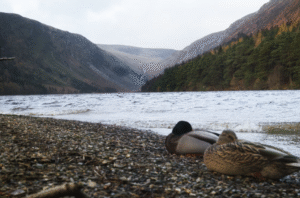
Glendalough: Where St Kevin Built a City in the Wilderness
Founded in the sixth century by St Kevin, Glendalough grew from a woodland hermitage into one of the most important monastic settlements in the early medieval world. At its height, it housed thousands of monks and pilgrims, supported a scriptorium producing illuminated texts, and maintained an international reputation as a place of sanctity and scholarship. Its round tower—standing over 30 metres tall—is one of the finest surviving examples in Ireland.
The valley itself adds a dimension that no museum can replicate. The glacially carved landscape, the two still lakes, and the sense of removal from the everyday world that drew St Kevin here are all best appreciated on a private visit, ideally in the early morning before day-tripper coaches arrive.
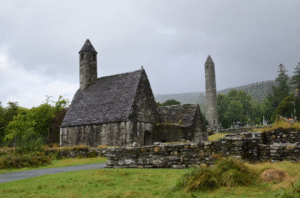
Monasterboice and the High Cross Tradition
If Glendalough represents the monastic settlement in its landscape, Monasterboice in County Louth represents the pinnacle of early Irish artistic achievement in carved stone. The site contains two of the finest High Crosses in existence—Muiredach’s Cross and the West Cross — both dating to the tenth century and decorated with narrative biblical panels of extraordinary intricacy.
These crosses were teaching tools for communities where literacy was not universal, their carved scenes telling the stories of Scripture with remarkable visual confidence. Boyne Valley heritage tours that include Monasterboice give you the opportunity to stand before these monuments with a guide who can read and explain their imagery, turning a pleasant visit into a genuinely illuminating encounter with early Irish Christian art.
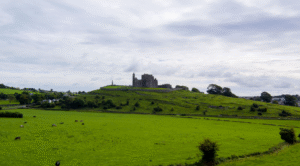
The Rock of Cashel: Where Faith Met Kingship
In County Tipperary, the Rock of Cashel rises abruptly from the surrounding plain, its cluster of medieval structures, round tower, Romanesque chapel, and Gothic cathedral, visible for miles in every direction. The site was the seat of the kings of Munster before being gifted to the church in 1101, carrying both political and spiritual authority. Cormac’s Chapel, built between 1127 and 1134, is one of the finest examples of Romanesque architecture in Ireland. Ireland heritage tour packages that include Cashel place this extraordinary site in proper context — not as a picturesque ruin, but as a pivot point between the native Irish tradition and the incoming Norman world.
Trim Castle and the Shift to a New Order
The twelfth century brought profound change to Ireland. The Norman invasion of 1169 introduced new forms of political organisation, architecture, and ecclesiastical structure that transformed the island’s landscape permanently. Trim Castle day tours illuminate this transition: the castle, built by Hugh de Lacy after 1172, is the largest Anglo-Norman fortification in Ireland, and its scale was a deliberate assertion of new power in a landscape previously organised around monastic sites and ringfort settlements. Placing Trim in sequence with Glendalough and Monasterboice tells a larger story about how Ireland changed in the twelfth century — one that is much harder to grasp when sites are visited in isolation.
Genealogy and the Search for Personal History
For many visitors of Irish descent, the journey into Ireland’s past is also a journey into their own family’s story. The monasteries and parishes of early and medieval Ireland were the keepers of records, and many of those records, where they survived, can be traced to specific places and communities. Genealogy tours of Ireland combine archival research with a guided visit to the places those records describe, creating an experience that connects ancient history to personal heritage in a uniquely powerful way.
Royal Historical Tours is partnered with My Ireland Heritage, specialising in locating ancestors to their precise location in the 1800s. Ancestral research tours in Ireland led by Ian Darragh, himself a certified genealogist, have produced moments of extraordinary discovery: a family name on a centuries-old headstone, a ruined cottage that matches a description in a family letter, a townland name appearing in both a nineteenth-century parish register and on the current Ordnance Survey map.
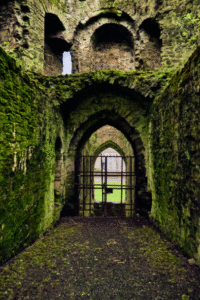
Walk in the Footsteps of Ireland’s Saints and Scholars
Royal Historical Tours’ Saints and Scholars tour in Ireland is the ideal choice for travellers who want to engage meaningfully with the island’s extraordinary intellectual and spiritual heritage. Whether you combine it with Meath day tours, a Dublin driving tour, or a genealogy and family history tour in Ireland, we will design a private, expert-guided experience that brings the early medieval world genuinely to life.
Contact us today to begin planning your journey into the heart of Ireland’s most enduring story.